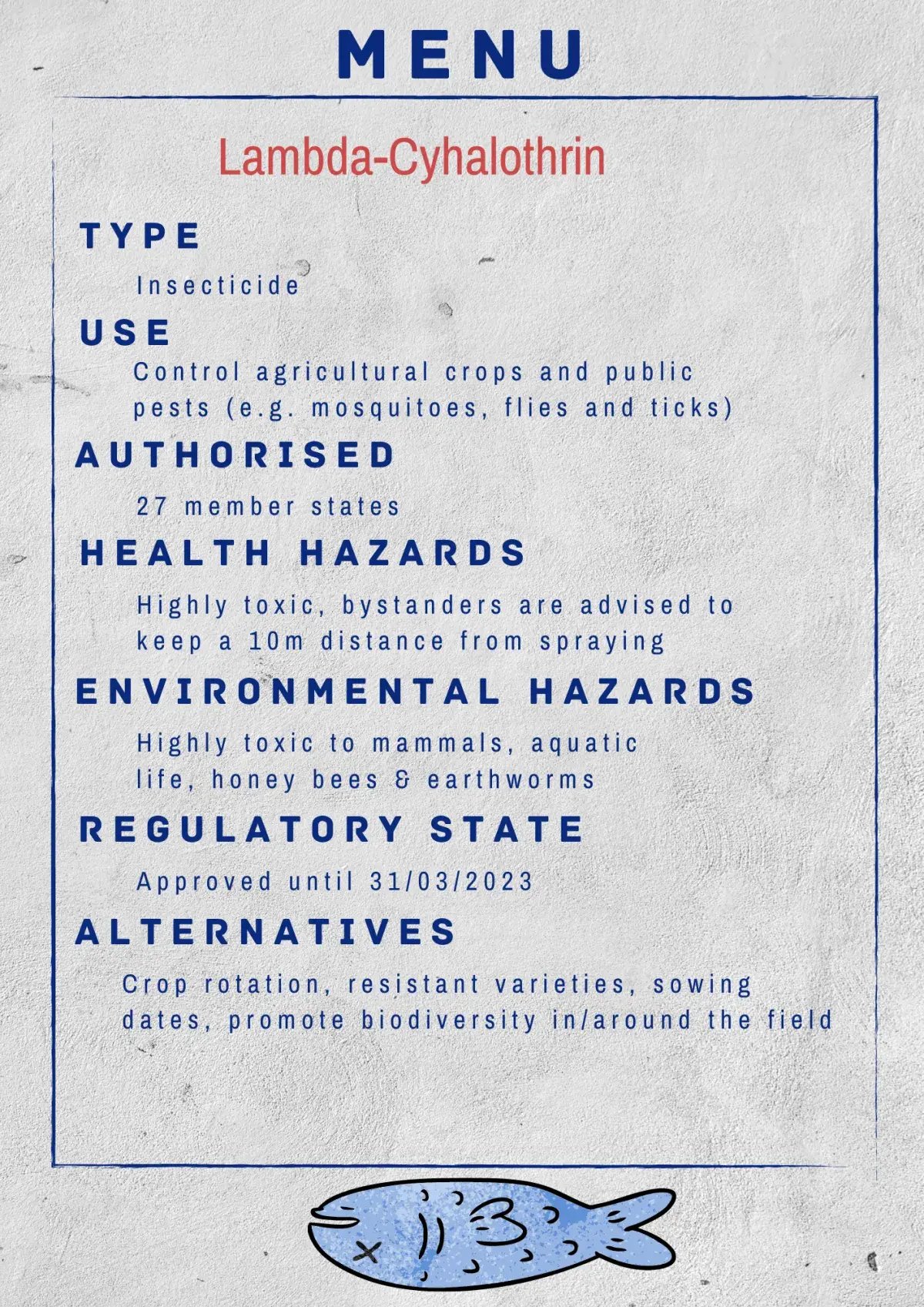
Acutely toxic in short term exposure. Very neurotoxic: bystanders are advised to keep a 10-meter distance from spraying. Independent studies suggest interactions of lambda-cyhalothrin with receptors of the endocrine and immune systems.
Highly toxic to mammals and fish, aquatic invertebrates and honey bees; moderately toxic to earthworms. Classified as acute and chronic very toxic to aquatic life.
Data gap: bioaccumulation in aquatic and terrestrial food chains.
Authorised in all 27 member states.
Residues present in food are very high.
195 Maximum Residue Limits (MRLs) above the Level of detection (LOD) of 0.01 mg/kg are established, ranging from 0.002mg/kg to 10.00 mg/kg per product (top 10 highest MRLs).
Approved until 31/03/2023.
A quick-acting insecticide used to control a wide spectrum of agricultural crops and public pests, e.g. mosquitoes, flies and ticks. Authorised uses include spraying fields of wheat or potatoes with tractor-mounted sprayers, ground directed spray and foliar spraying.
Crop rotation, resistant varieties, sowing dates, promote biodiversity in/around the field.