
Today, 26th October 2016, the European Food Safety Authority (EFSA) published its annual report on pesticide residues found in food in the EU member states. Year after year, the proportion of food without detectable residues is decreasing while the proportion of food that contains residues from multiple pesticides is increasing...
Gooseberries, currants and strawberries are among the favourite fruits of children. Having a fresh orange or grape fruit juice is seen as a healthy habit. That might not be true according to the report EFSA published today: more than 60% of these fruits contain several residues of pesticides, gooseberries peaking at 91.1% of the tested samples.
While the EFSA communicates on the figure that 97% of the food European consumers eat are ‘safe’ as residue levels are below the maximum residue limits (MRLs), a careful reading of the figures does not lead to the same conclusions.
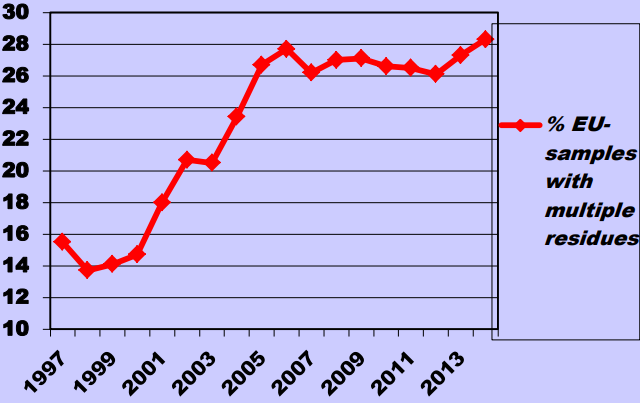
46.3% of the analysed food contained at least one residue of pesticides. The EFSA states it is safe for 43.4% of the analysed food as it is under the MRL. PAN Europe does not agree with this statement. Firstly, the MRL is something theoretical, based on the knowledge of the moment. MRLs are regularly reduced because of the new findings in the toxicity of a pesticide. Then, 61% of the contaminated food contains more than one residue. What EFSA does not communicate on, is that there is currently no risk assessment of the toxicity of combined exposures: the risk assessment is carried out pesticide by pesticide, individually and not in combination! It is thus incorrect to classify this food as ‘safe’ for human health. As can be observed on the graph below, the situation is getting worse year after year.
2014 the percentage of multiple residues in European vegetables and fruit increased again to the extreme high rate of 28.3%.
Unfortunately EFSA stopped publishing the data on the highest reported number of different pesticides in one sample, which was close to 30 different pesticides in one food item (grapes, raisins) in the report from last year.
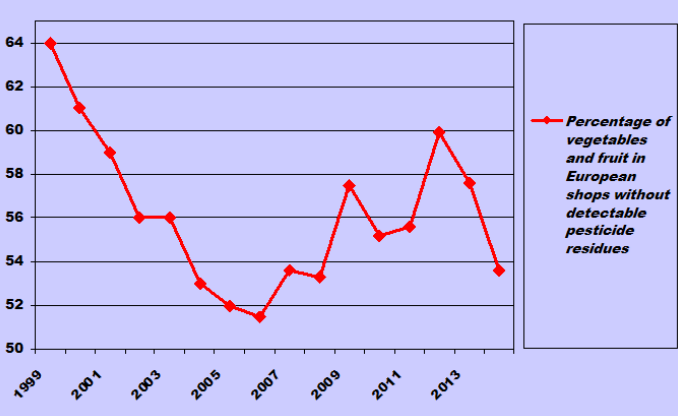
In 2014 the percentage of vegetables and fruit in European shops without detectable pesticide residues went down again considerable to 53.6% as was the case in 2013, close to the all-time low in 2007.
Other interesting findings in this report are that meat often contains residues of persistent pesticides that were banned many years ago due to their toxicity to human health. Furthermore, the very famous glyphosate herbicide is not often monitored, especially when it comes to testing GM soy bean that is known to contain staggering levels of this pesticide, that it passes then to humans through consumption of meet and to newborn babies through breast milk This awkward non-measurement of glyphosate is suspicious as it is one of the most used pesticides around the world.
Hans Muilerman, PAN-Europe’s chemical officer says: ‘When we look at the way EFSA communicates these figures year after year, it gives the impression that their role is to ensure a feeling of protection for European consumers rather than to effectively protect EU citizen’s health. 10 years ago, the EFSA was requested to assess the risk of exposure to multiple residues of pesticides. Nothing has been implemented up to now, despite the evidence that the current method is not safe.’
Angeliki Lyssimachou, PAN Europe’s expert on endocrine disruptor says: ‘Several pesticides are endocrine disruptors that we are exposed to in our daily lives. Pesticidefree food should be the norm to protect children or the unborn. MRLs is a theoretical concept, sometimes a political one, as it was arbitrarily raised to import more GM soy to Europe. EFSA should not communicate on food being safe based on MRLs, but based on the absence of pesticide residues!’
Contacts: PAN Europe, martin@pan-europe.info: +32 (0) 486 32 99 92