Tomorrow, 27 March 2017, another Forum for the Future of Agriculture (FFA) conference, jointly organized by the European Landowners Organisation (ELO) and Syngenta, will be hosted at the Square in Brussels. As this year’s topic is ‘time for solutions’, it would be the right moment to also talk about the future of the Common Agricultural Policy (CAP), as CAP reform discussions have already started.
Almost 400,000 tons of active substances are sold in the EU to be sprayed on Europe's fields each year. Pesticide Action Network Europe (PAN Europe) has made a simple overview showing the link between pesticide sale and direct payments of the Common Agricultural Policy (1) (2).
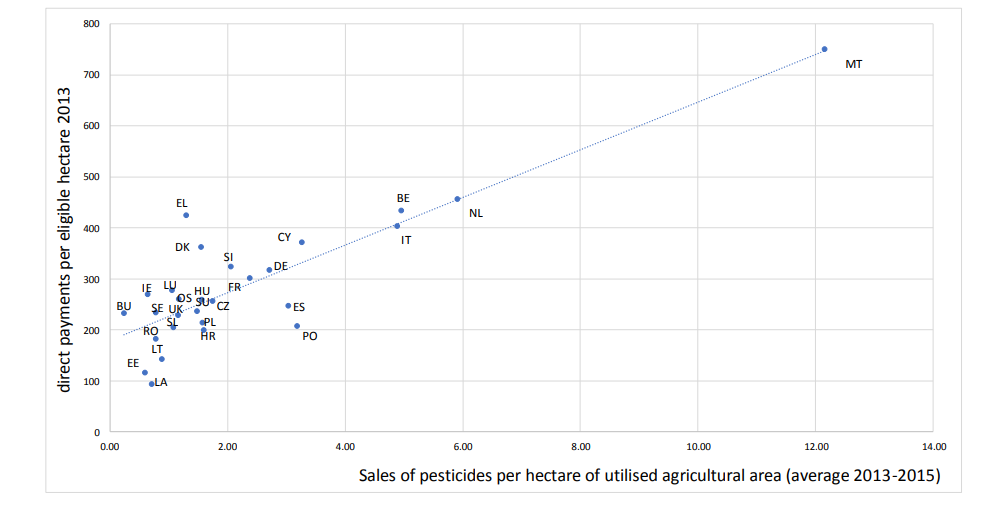
We dare to question whether it is logical that taxpayers’ money is going to pay the highest direct payments per hectare to Member States with the highest sale of pesticides/hectare?
One of the big problems with the current CAP is that there are no mandatory instruments to encourage a transition towards a low inputs farming. The only mandatory requirement is, farmers must use pesticides approved for use in Europe (3). Member States can – but do not have to - offer farmers financial compensation for reduced use of pesticides (4). However, there are no mandatory requirements in the CAP stating that in order to receive direct payment farmers have to make plans on reducing pesticide use and have to prove that they apply integrated pest management although this has been mandatory for farmers to apply since January 2014 (5). Finally, in almost all Member States, 0 100 200 300 400 500 600 700 800 0.00 2.00 4.00 6.00 8.00 10.00 12.00 14.00 MT Sales of pesticides per hectare of utilised agricultural area (average 2013-2015) direct payments per eligible hectare 2013 EL NL CY I T BE DK SI DE FR ES PO PL HR CZ HU SU O S I E LU SE UK SL RO LT EE LA BU farmers can still use pesticides in the Ecological Focus Areas, areas meant to encourage biodiversity (6).
PAN Europe calls for a serious reform of the CAP, away from supporting business as usual, and into a model supporting farmers by different means in transitions towards low input farming systems.
PAN Europe also calls on ELO and Syngenta to make reduced chemical dependency in EU farming the topic of next year’s FFA, moving away from talking about single instruments like precision farming to instead start talking about combinations of instruments which are able to ensure the uptake of diversified farming systems less dependent of chemical inputs.
Notes:
(1) The table is based on Eurostat, except estimates for pesticide sale in Cyprus and Luxembourg are classified by the national government as confidential, and therefore numbers appearing in the tables are estimated by PAN Europe.
(2) The most active substance sold and used in Malta is Sulphur, which covers around 65% of total sales and also around 90% of total active substances used (from Eurostat)
(3) In CAP terminology: the EU regulation (EC) 1107/2009 on authorisation of pesticides is one of the statutory mandatory requirements of cross compliance.
(4) For instance, France and Luxembourg offer farmers financial support to farmers on a voluntary basis for uptake of biological control able to replace insecticides and herbicides in wine growing.
(5) According to article 14 of the EU Directive 128/2009 on sustainable use of pesticides
(6) The European Commission is as part of the simplification exercise of the greening of the CAP proposing to ban use of pesticide on productive areas of the EFAs, but this proposal is still in negotiation.
Contacts: Henriette Christensen, Senior Policy Officer, PAN Europe, henriette@pan-europe.info, Tel: +32 2 318 62 55
Note to editor: PAN Europe is a network of NGOs working to minimise negative effects and replace the use of hazardous chemicals with ecologically sound alternatives. We work to eliminate dependency on chemical pesticides and to support safe sustainable pest control methods. Our network brings together 34 consumer, public health, and environmental organisations, and women's groups from across Europe.